
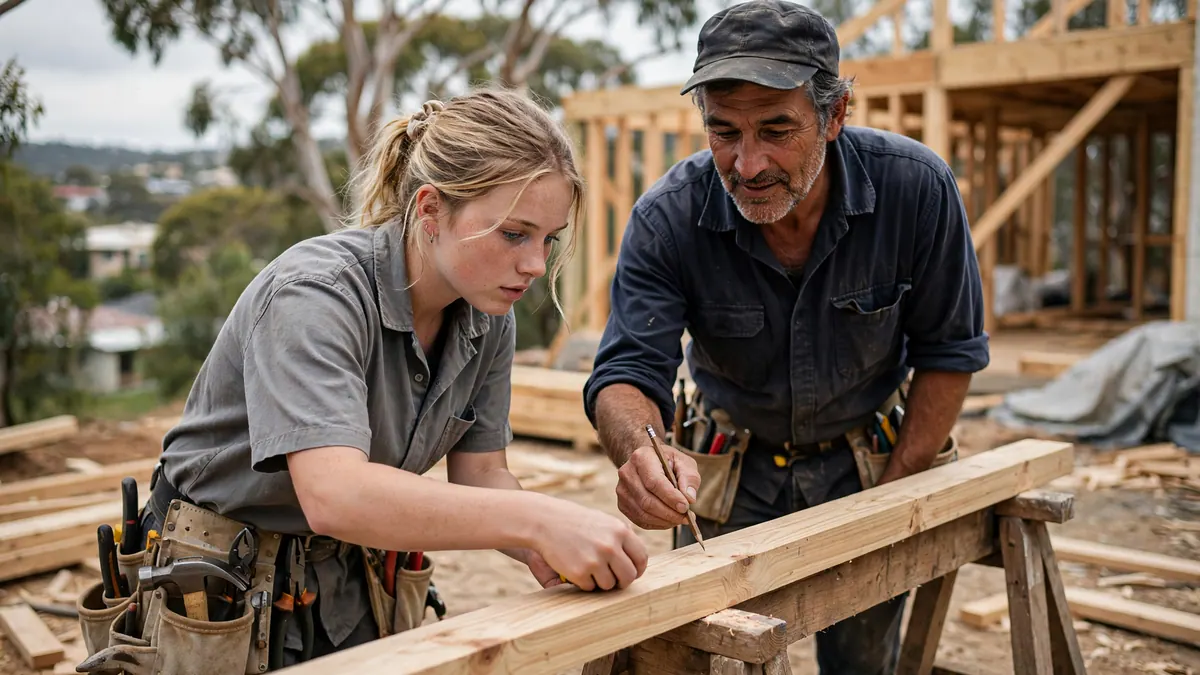
Apprentice Carpenter Pay by Year
These are the minimums for an apprentice carpenter on a standard four-year term, from the first full pay period starting on or after 1 July 2026, as the Fair Work Ombudsman pay guide prints them for the carpenter and joiner group. They include the tool and industry allowances, because the award makes both part of an apprentice’s ordinary rate. Your rate may be higher under an enterprise agreement or if your employer pays above the award; it cannot lawfully be lower.
General building, civil or engineering construction site
| Year | No Year 12: hourly | No Year 12: weekly | Year 12: hourly | Year 12: weekly |
|---|---|---|---|---|
| 1st year (stage 1) | $17.58 | $667.92 | $19.05 | $723.88 |
| 2nd year (stage 2) | $20.52 | $779.83 | $21.99 | $835.79 |
| 3rd year (stage 3) | $24.94 | $947.70 | $24.94 | $947.70 |
| 4th year (stage 4) | $29.36 | $1,115.56 | $29.36 | $1,115.56 |
Fair Work Ombudsman pay guide, Building and Construction General On-site Award [MA000020], “Carpenter and/or joiner (including bridge and wharf), carver, floor sander, letter cutter, stonemason, artificial stoneworker, marble and slate worker or tilelayer”, general building and construction, not residential work. Includes the $41.22 tool allowance and the $67.15 industry allowance. 4-year apprentice who started on or after 1 January 2014, 38-hour week, from the first full pay period starting on or after 1 July 2026.
Residential building (single or dual occupancy, not multistorey)
| Year | No Year 12: hourly | No Year 12: weekly | Year 12: hourly | Year 12: weekly |
|---|---|---|---|---|
| 1st year (stage 1) | $17.22 | $654.49 | $18.70 | $710.45 |
| 2nd year (stage 2) | $20.17 | $766.40 | $21.64 | $822.36 |
| 3rd year (stage 3) | $24.59 | $934.27 | $24.59 | $934.27 |
| 4th year (stage 4) | $29.00 | $1,102.13 | $29.00 | $1,102.13 |
Fair Work Ombudsman pay guide, Building and Construction General On-site Award [MA000020], “Carpenter and/or joiner (including bridge and wharf), carver, floor sander, letter cutter, stonemason, artificial stoneworker, marble and slate worker or tilelayer”, residential work. Includes the $41.22 tool allowance and the $53.72 industry allowance. 4-year apprentice who started on or after 1 January 2014, 38-hour week, from the first full pay period starting on or after 1 July 2026.
How the Carpenter Rate Is Built
Clause 19.7(b) of the award sets the wage as a percentage of the $1,119.10 standard rate, and clause 19.7(c) adds the clause 21.1 tool allowance and the clause 22 industry allowance as part of the ordinary weekly rate for all purposes. The wage part alone is:
| Year | No Year 12: hourly | No Year 12: weekly | Year 12: hourly | Year 12: weekly |
|---|---|---|---|---|
| 1st year (stage 1) | $14.73 | $559.55 | $16.20 | $615.51 |
| 2nd year (stage 2) | $17.67 | $671.46 | $19.14 | $727.42 |
| 3rd year (stage 3) | $22.09 | $839.33 | $22.09 | $839.33 |
| 4th year (stage 4) | $26.51 | $1,007.19 | $26.51 | $1,007.19 |
Building and Construction General On-site Award 2020 [MA000020], cl 19.7(b)(i). Junior apprentice who started on or after 1 January 2014, 38-hour week, in force from the first full pay period starting on or after 1 July 2026. Wage only, before the tool and industry allowances.
That wage table is the same for bricklayers and painters, because the award has one percentage scale for its apprentices. What differs is the tool allowance: $41.22 a week for carpenters. Adding it and the industry allowance to the wage gives the pay guide figure in every row:
| Year | Wage (Year 12) | Tool allowance | Industry allowance (general) | Total a week | Hourly (total / 38) |
|---|---|---|---|---|---|
| 1st year (stage 1) | $615.51 | $41.22 | $67.15 | $723.88 | $19.05 |
| 2nd year (stage 2) | $727.42 | $41.22 | $67.15 | $835.79 | $21.99 |
| 3rd year (stage 3) | $839.33 | $41.22 | $67.15 | $947.70 | $24.94 |
| 4th year (stage 4) | $1,007.19 | $41.22 | $67.15 | $1,115.56 | $29.36 |
Our arithmetic on cl 19.7(b), 21.1(a) and 22.1(a); every total matches the Fair Work Ombudsman pay guide. On residential work the industry allowance is $53.72 (cl 22.1(b)).
Adult vs Junior Start
A person who starts as an adult apprentice and was not already employed by the same employer is paid the greater of the ordinary hourly rate for the lowest classification in clause 19.1 (Level 1 (a)) and the rate for their year (cl 19.8(d)). The award's ordinary hourly rate includes the industry allowance and any all-purpose allowance, so for a carpentry apprentice it includes the $41.22 tool allowance too. The Fair Work Ombudsman pay guide works this out at $29.52 an hour ($1,121.87 a week) on general building sites and $29.17 ($1,108.44) on residential work, in every year, because even the 90% fourth-year rate is lower. A person who was employed by the employer for at least 6 months full-time or 12 months part-time or as a regular casual before starting keeps the hourly rate they were on (cl 19.8(a) to (c)).
How Much Do Apprentice Carpenters Earn After Tax?
On the general building site minimum, which includes the tool and industry allowances, a first-year apprentice carpenter on a full-time 38-hour week is paid about $37,643 a year (Year 12 completed) and takes home about $666.65 a week. By fourth year the same hours give about $58,015 gross and $943.46 a week after tax. Apprentices pay the same income tax as everyone else, but the low income offset and the tax-free threshold mean the tax in the early years is small.
| Year | Yearly gross (Year 12) | Weekly take-home (Year 12) | Yearly gross (no Year 12) | Weekly take-home (no Year 12) |
|---|---|---|---|---|
| 1st year (stage 1) | $37,643 | $666.65 | $34,738 | $620.85 |
| 2nd year (stage 2) | $43,452 | $753.81 | $40,548 | $710.23 |
| 3rd year (stage 3) | $49,281 | $831.75 | $49,281 | $831.75 |
| 4th year (stage 4) | $58,015 | $943.46 | $58,015 | $943.46 |
General building site minimum including the tool and industry allowances, 38 hours a week for 52 weeks, resident taxpayer, 2026-27 rates with the low income offset and Medicare levy, private hospital cover, no HELP debt. Overtime and other allowances are not included.
To see your own figure, put your hourly rate and hours into the calculator above, or use the take-home pay calculator to add overtime. Your hourly rate to a yearly salary is on the hourly to annual salary calculator.
What Is Specific to Carpenter Apprentices
The $41.22 is shared by everyone in the same line of clause 21.1(a): joiners, bridge and wharf carpenters, carpenter-divers, carvers, floor sanders, letter cutters, stonemasons, tilelayers and marble, slate and artificial stone workers. The Fair Work Ombudsman pay guide prints one apprentice table for that whole group, and the tables on this page are that table.
A qualified carpenter or joiner is a CW/ECW 3 classification (Schedule A.2.3). The award places a joiner special class at CW/ECW 4 ($1,154.40 a week) and a carpenter-diver at CW/ECW 8 ($1,286.70), and a carpenter-diver also gets $1.33 an hour for all purposes (cl 23.5). Once the apprenticeship is complete, clause 19.7(a) sets the floor at the $1,119.10 standard rate, so with the tool and industry allowances a carpenter on a general building site is on at least $1,227.47 a week.
The training plan that sets your stage dates is for the Certificate III in Carpentry. Apprentices who signed up under CPC30220 and those under its replacement CPC30326 progress the same way: stage 2 at 25% of the competencies in the training plan or 12 months after starting, stage 3 at 50% or 12 months after stage 2, stage 4 at 75% or 12 months after stage 3, whichever is earlier each time (cl 19.7(b)).
Qualification: CPC30326 Certificate III in Carpentry. training.gov.au released CPC30326 on 23 September 2026 (34 units: 27 core and 7 elective) and marked the previous CPC30220 superseded from 22 September 2026, listing the two as equivalent.
Once qualified, see carpenter pay rates (qualified). Other award detail: Building and Construction Award rates.
Check Your Payslip
- Find your year of apprenticeship and whether you completed Year 12 and read the matching hourly figure in the first table for your type of site.
- Your payslip may show the wage and the tool and industry allowances as separate lines; add them before comparing with the table. The payslip guide explains each line.
- If you are paid less, ask your employer to explain which award or agreement they use, then contact the Fair Work Ombudsman on 13 13 94. The backpay calculator shows what a shortfall adds up to.
Pre-2014 apprentices, three-year terms, school-based apprentices and trainees are paid under other schedules and are not covered here. Rates change each 1 July, so check the date on this page.
Other Apprentice Pay Guides
- Apprentice Pay Rates by Trade: every trade side by side
- Apprentice Electrician Pay: adult, junior and penalty rates
- Apprentice Bricklayer Pay
- Apprentice Painter Pay
- Apprentice Plumber Pay
- Apprentice Mechanic Pay
- Apprentice Hairdresser Pay
- Apprentice Chef Pay
- Apprentice Boilermaker Pay
- Apprentice Butcher Pay
- Junior Pay Rates for non-apprentices
Frequently Asked Questions
Apprentice carpenter pay questions and answers
How much does a first-year apprentice carpenter earn?
From 1 July 2026 the minimum for a first-year apprentice carpenter on a general building, civil or engineering construction site is $17.58 an hour ($667.92 a week) without Year 12 and $19.05 an hour ($723.88 a week) with it. That includes the $41.22 tool allowance and the $67.15 industry allowance, which the award pays apprentices for all purposes. On residential building work it is $17.22 and $18.70 an hour.
How much does a fourth-year apprentice carpenter earn?
The minimum in fourth year is $29.36 an hour ($1,115.56 a week) on a general building site and $29.00 an hour on residential work, from 1 July 2026, with or without Year 12. Both include the tool and industry allowances.
How much do apprentice carpenters earn after tax?
On the general building site minimum, which includes the tool and industry allowances, for 38 hours a week all year, a first-year apprentice carpenter (Year 12 completed) earns about $37,643 a year before tax and takes home about $666.65 a week. In fourth year the same hours give about $58,015 gross and $943.46 a week after tax and the Medicare levy. These use the 2026-27 resident rates, private hospital cover and no HELP debt, and leave out overtime and other allowances.
Do adult apprentice carpenters get paid more than juniors?
Yes. An adult apprentice carpenter who was not already working for the employer is paid at least the award's lowest ordinary hourly rate with the allowances included (cl 19.8(d)): $29.52 an hour on general building sites and $29.17 on residential work, in every year, against $19.05 in first year for a junior with Year 12 on a general site.
Is the tool allowance included in the apprentice carpenter rate?
Not in the percentage of the standard rate, but it is part of the minimum. Clause 19.7(b) and (c) of the Building and Construction General On-site Award make an apprentice's minimum the percentage rate plus the $41.22 carpenter tool allowance and the industry allowance, for all purposes. The Fair Work Ombudsman pay guide figures on this page, such as $19.05 an hour in first year with Year 12 on a general building site, already include both.
Do apprentice carpenters get paid more on a commercial site than on a house?
Yes, by $13.43 a week, which is the gap between the two industry allowances: $67.15 on general building, civil and engineering construction work and $53.72 on residential building (single or dual occupancy, not multistorey). In first year with Year 12 that is $19.05 an hour against $18.70.
When does an apprentice carpenter's pay go up?
Two things lift it. The wage steps up at each stage of the apprenticeship, usually each year, and earlier where the award lets an apprentice move up when they complete enough of their training plan for the Certificate III in Carpentry. And every award minimum rises each 1 July with the Fair Work Commission's Annual Wage Review, from the first full pay period starting on or after that date.
How we worked this out▼
The pay tables are the Fair Work Ombudsman pay guide for the Building and Construction General On-site Award, published 2 July 2026, for the carpenter and joiner group. We checked every row against the award: the clause 19.7(b) percentage of the $1,119.10 standard rate, plus the $41.22 clause 21.1(a) tool allowance, plus the clause 22.1 industry allowance, gives the pay guide’s weekly figure to the cent, and the hourly figure is that total divided by 38 and rounded to the cent. The bare wage table is the award’s percentage applied to the standard rate.
Take-home is the site’s 2026-27 resident calculation for 38 hours, 52 weeks, with the low income offset and the Medicare levy (private hospital cover, no HELP debt). The qualification details are from training.gov.au, checked 9 October 2026.
Scope: a junior apprentice on a four-year term who started on or after 1 January 2014. Pre-2014 apprentices, three-year terms, school-based apprentices, trainees, enterprise agreements and state licensing rules are not modelled. General information, not advice.
Sources & References
- 1Building and Construction General On-site Award 2020 [MA000020], cl 19.7(b)(i)— Fair Work Commission
- 2Pay guide: Building and Construction General On-site Award 2020 [MA000020]— Fair Work Ombudsman
- 3CPC30326 Certificate III in Carpentry— training.gov.au
- 4Annual Wage Review 2025-26 decision [2026] FWCFB 3500— Fair Work Commission
- 5Tax rates for resident individuals 2026-27— Australian Taxation Office
Last verified: 9 October 2026. Our content is based on the latest information from official Australian government sources.
Anita Bell
AuthorFounder & Senior Bookkeeper
Accountancy degree (2015); certified in Xero, QuickBooks Online, MYOB, Saasu, Zoho and Reckon One
Anita Bell earned her accountancy degree in 2015 and has worked as a senior bookkeeper with Prime Bookkeeping for over 5 years. This built her skills in Australian and New Zealand tax legislation and industry regulations. She is certified in Xero, QuickBooks Online, MYOB, Saasu, Zoho and Reckon One, and works with payroll and rostering software including Gusto, Deputy, Tsheets and KeyPay. She has strong experience in hospitality, building and construction, financial services, real estate, ecommerce, and medical and health services.
Areas of Expertise