Every salary on this page is the agreement's "24 months" column, a 3.4% rise that took effect on 7 October 2026 and the last scheduled under this agreement. Figures re-read from Attachment 1 on 9 October 2026.
The SY TTCU and SY CSS/Supervisor classifications closed to new employees from 1 July 2025 and are grandfathered for existing employees who meet clauses 27.14 to 27.21.
These are base salaries only. Controllers' actual earnings also include penalty rates, overtime and allowances, which vary by roster and location.
Air traffic controllers in the Australian Defence Force are paid under ADF pay scales, not this agreement.
The agreement reaches its nominal expiry date on 7 October 2027. Salaries after that depend on a replacement agreement.
How air traffic controller pay is set
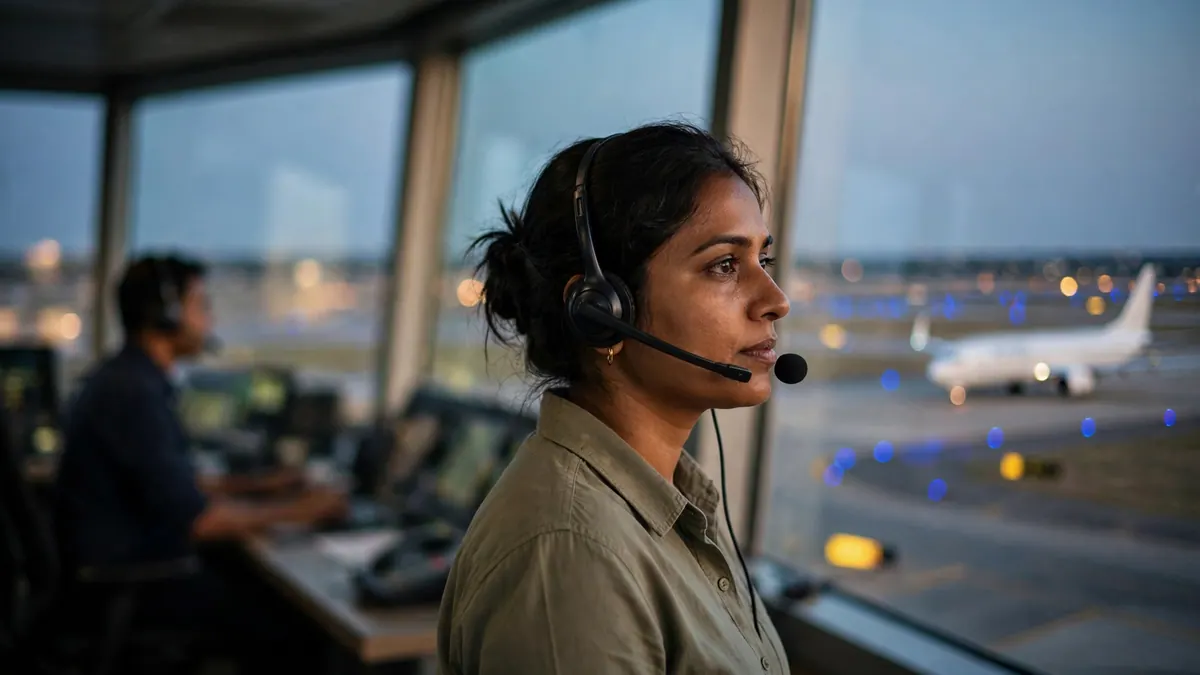
Civil air traffic controllers in Australia are employed by Airservices Australia, a Commonwealth corporate entity. Their pay is set by an enterprise agreement approved by the Fair Work Commission, which sits over the Airservices Australia Enterprise Award 2016 as the safety net.
The agreement pays a base salary by classification: trainees are paid a training salary while they complete the Airservices course, then move onto the controller classifications as they gain ratings and endorsements. Shift work and the complexity of the airspace a controller works attract separate payments on top of base salary.
Air traffic controllers in the Royal Australian Air Force are ADF members paid under the ADF pay scales, not this agreement.
The figures on this page come from the Airservices Australia (Air Traffic Control and Supporting Air Traffic Services) Enterprise Agreement 2024-2027. Approved by the Fair Work Commission on 30 September 2024 ([2024] FWCA 3415, AG2024/2680); operates from 7 October 2024; nominal expiry date 7 October 2027.
Air traffic controller pay scale 2026
Annual full-time base salary before tax and before superannuation.
Air traffic controller classification and base salary (Attachment 1)
Base salaries for Airservices air traffic controllers, from ab initio trainee through the licensed Level 1 to Level 10 scale to the supervisor classifications. Figures are the agreement's "24 months" column, in force from 7 October 2026.
| Classification | Annual salary | Notes |
|---|---|---|
| Ab Initio Trainee | $64,398 | In initial training, before any ATC licence |
| Field Trainee | $92,251 | On-the-job final field training |
| Level 1 | $125,564 | |
| Level 2 | $140,941 | |
| Level 3 | $156,315 | |
| Level 4 | $169,981 | |
| Level 5 | $183,648 | |
| Level 6 | $199,878 | |
| Level 7 | $213,544 | |
| Level 8 | $227,212 | |
| Level 9 | $234,898 | |
| Level 10 | $243,589 | Top of the controller progression scale |
| SY TTCU | $260,422 | Grandfathered: closed to new employees from 1 July 2025 |
| UTS | $266,142 | Unit Tower Supervisor |
| CSS / SS | $266,142 | |
| SY CSS/Supervisor | $286,463 | Grandfathered: closed to new employees from 1 July 2025 |
Flight Data Co-ordinator (FDC) classification and base salary
Base salaries for Flight Data Co-ordinators covered by the same agreement. Figures are the "24 months" column, in force from 7 October 2026.
Simulator Support Officer (SSO) classification and base salary
Base salaries for Simulator Support Officers, who support ATC training simulators. Figures are the "24 months" column, in force from 7 October 2026.
| Classification | Annual salary | Notes |
|---|---|---|
| Trainee | $87,184 | |
| SSO1 - Level 1 | $95,766 | |
| SSO2 - Level 2 | $101,463 | |
| SSO3 - Level 3 | $107,222 | |
| SSO4 - Level 4 | $110,579 | |
| SSO5 - Level 5 Fully Endorsed SSO | $114,002 | |
| SSO6 - Level 6 Multi-Skilled SSO | $118,220 | |
| SSO7 - Level 7 Exercise Design and Development | $120,939 | |
| SSO8 - Level 8 Competency, Training and Standards | $133,034 | |
| SSO9 - Level 9 Simulator Data and Design SSO Instructor - ASA ATC Instructor Higher Duties | $138,594 | |
| Supervisor | $155,919 |
Airways Data Team (ADT) classification and base salary
Base salaries for the Airways Data Team (previously the TAAATS Data Management Unit). Figures are the "24 months" column, in force from 7 October 2026.
Every salary links to its take-home figure. Take-home pages exist for every $1,000 up to $150,000 and in wider steps above that, so a salary without a page of its own links to the nearest one.
Air traffic controller trainee pay
An Ab Initio Trainee is paid $64,398 a year under the agreement's "24 months" column, in force from 7 October 2026 (it was $62,280 under the "12 months" column). Schedule 1 defines an Ab Initio as an employee who does not hold, and has never held, an air traffic control licence and is undergoing Airservices training to become a licensed controller.
Under Schedule 1, Ab Initios are not required to work night shifts or to perform ordinary hours on Saturdays or Sundays.
An Ab Initio moves to the Field Trainee classification ($92,251) when they start final field training, or automatically two weeks (14 days) after finishing the Ab Initio course if field training has not started by then.
Airservices' careers FAQ says initial training may take up to 18 months, followed by on-the-job field training managing live traffic with an instructor for about three to six months. Trainees work Monday to Friday, about 7.5 hours a day, during initial training.
Once at Level 1, a controller moves up one classification level per year to Level 10, provided their performance is satisfactory and they meet the conditions in clause 27.3 (ASIC renewal, mandatory training, exams and CASA Class 3 medical on time).
The FAQ says new recruits must sign a Training Bond Agreement committing to Airservices for five years after completing training, and must repay a proportion of training fees if the bond is broken.
Allowances, rosters and loadings
- Additional hours: ATC and FDC employees who work outside their ordinary hours are paid at 1.90 for all additional hours, with a minimum of four hours if recalled to duty after ceasing work (clause 20.22).
- Public holidays: ordinary duty on a public holiday is paid at 1.97 times the hourly rate; a controller on a rostered day off on a public holiday gets a 0.79 penalty for the average hours per shift of their base roster, or time off in lieu (clause 20.27).
- Ordinary hours: rostered ordinary hours average no more than 72 hours per fortnight, including shift hand-over duties (clause 20.3).
- Night shift leave: two extra hours of leave are credited for each night shift, or shift starting or ending between 0001 and 0459, up to 72 hours a financial year (clause 53).
- On-the-job training instructor (OJTI) allowance: 20% of base salary for ATC/FDC, 15% for SSO and 10% for supervisor positions (SS, UTS, CSS and SM) while instructing (clause 24.13).
- ATC instructors at the Academy receive a 5% higher duties allowance if they keep a current Class 3 medical and ATC licence (clause 24.1(g)).
- Multi-skill allowance: $100, $150 or $200 per fortnight for Tier 1, 2 or 3 (clause 24.15). Portfolio allowance: $60 per fortnight per portfolio (clause 24.16).
- District allowance is paid at listed remote locations — for example $7,079.47 a year (with eligible dependants) or $5,043.02 (without) at Broome, Port Hedland and Karratha (clause 24.10).
- Superannuation for accumulation members: the higher of 14% of base salary plus listed allowances (shift allowance, public holiday penalties, higher duties, OJTI and others) or the Superannuation Guarantee minimum (clause 34.4).
Other agreements
- Airservices Australia Enterprise Award 2016 [MA000141]: The award the enterprise agreement was tested against at approval (the better off overall test). It is the safety net for Airservices employees; the enterprise agreement salaries above are what controllers are actually paid.
What a air traffic controller salary is worth after tax
Every salary in the tables links to its take-home figure — for example take-home pay on $64,000 and take-home pay on $240,000. Allowances and loadings are taxed as ordinary income on top of base salary.
What this page does not show
- The agreement's salary table is headed "On Commencement", "12 months" and "24 months" without naming a pay period. The dates on this page (7 October 2025 and 7 October 2026) are 12 and 24 months after the 7 October 2024 commencement date in the FWC decision; the exact pay period in which each rise was or will be paid is not printed in the table.
- Salary-related allowances in clause 24 (for example the workplace responsibility and community language allowances) print their increases from the first full pay period after 18 November 2024 and 18 November 2025. Those allowance dates differ from the salary table's column headings and are not used for salaries here.
- Overall earnings figures (base plus penalties and allowances) are not published by Airservices and are not estimated here.
Air traffic controller salary questions
How this page is sourced▼
Every figure was read from the Airservices Australia (Air Traffic Control and Supporting Air Traffic Services) Enterprise Agreement 2024-2027 and the other sources listed below on 9 October 2026. Nothing is estimated or taken from salary surveys. Where an instrument publishes a weekly rate, the annual figure is that rate multiplied out and the published rate is shown in the notes column.
Sources & References
- 1Airservices Australia (Air Traffic Control and Supporting Air Traffic Services) Enterprise Agreement 2024-2027, with FWC approval decision [2024] FWCA 3415 and correction— Airservices Australia / Fair Work Commission
- 2Air Traffic Control Classification Base Salary 2024-2027— Airservices Australia
- 3Air traffic control careers — frequently asked questions— Airservices Australia
- 4Airservices Australia Enterprise Award 2016 [MA000141]— Fair Work Commission
Last verified: 9 October 2026. Our content is based on the latest information from official Australian government sources.
Anita Bell
AuthorFounder & Senior Bookkeeper
Accountancy degree (2015); certified in Xero, QuickBooks Online, MYOB, Saasu, Zoho and Reckon One
Anita Bell earned her accountancy degree in 2015 and has worked as a senior bookkeeper with Prime Bookkeeping for over 5 years. This built her skills in Australian and New Zealand tax legislation and industry regulations. She is certified in Xero, QuickBooks Online, MYOB, Saasu, Zoho and Reckon One, and works with payroll and rostering software including Gusto, Deputy, Tsheets and KeyPay. She has strong experience in hospitality, building and construction, financial services, real estate, ecommerce, and medical and health services.
Areas of Expertise