Horticulture Award Pay Rates by Level
Hourly adult minimum rates (the rate a time-paid worker, or a pieceworker's floor, must receive) for full-time and part-time employees under the Horticulture Award 2020. Part-time employees are paid the same hourly rate as full-time employees at their classification — the difference is hours, not rate. The casual column adds the 25% loading (cl 11.2(a)).
| Classification level | Weekly (38 hrs) | Hourly | Casual hourly (+25%) |
|---|---|---|---|
| Level 1 | $978.10 | $25.74 | $32.18 |
| Level 2 | $1,004.90 | $26.44 | $33.05 |
| Level 3 | $1,020.10 | $26.84 | $33.55 |
| Level 4 | $1,056.90 | $27.81 | $34.76 |
| Level 5 | $1,119.10 | $29.45 | $36.81 |
Weekly rates are the award’s minimum weekly rate for a full-time employee (cl 15.1(a)); hourly is the weekly rate divided by 38.
Which level am I?
- Level 1: A new employee doing routine manual work under direct supervision, including general labouring and fruit or vegetable picking, thinning or pruning. Progresses to Level 2 after no more than 3 months' industry experience (Schedule A.1).
- Level 2: Has 3 months' industry experience; works under general supervision with established routines and exercises limited discretion (Schedule A.2).
- Level 3: Performs work above and beyond Level 2 under routine supervision and exercises discretion within their skills and training (Schedule A.3).
- Level 4: Coordinates work in a team or works individually under general supervision, with knowledge of the production process (Schedule A.4).
- Level 5: Works under minimal supervision, coordinates and schedules approved work in a team, and uses a trade qualification in their duties (Schedule A.5).
Piecework is allowed — but the hourly rate is a floor you cannot be paid below
An employer may pay full-time, part-time or casual horticulture workers a piece rate (cl 15.2). The award does not set the dollars per bucket, punnet or kilogram: the employer must fix a piece rate so that a competent worker (one with at least 76 hours' experience of the task) working at average productivity earns at least 15% more per hour than the hourly rate for their level, including the 25% casual loading for a casual. For a casual Level 1 picker the hourly rate is $32.18, so average productivity must produce at least $37.01 an hour. Whatever your piece rate yields, you must receive at least the hourly rate multiplied by the hours worked each day (cl 15.2(f)), and the employer must give you a written piecework record before you start. Overtime and the ordinary hours clauses do not apply to a pieceworker.
Worked example: a casual picker on piece rate versus the hourly floor
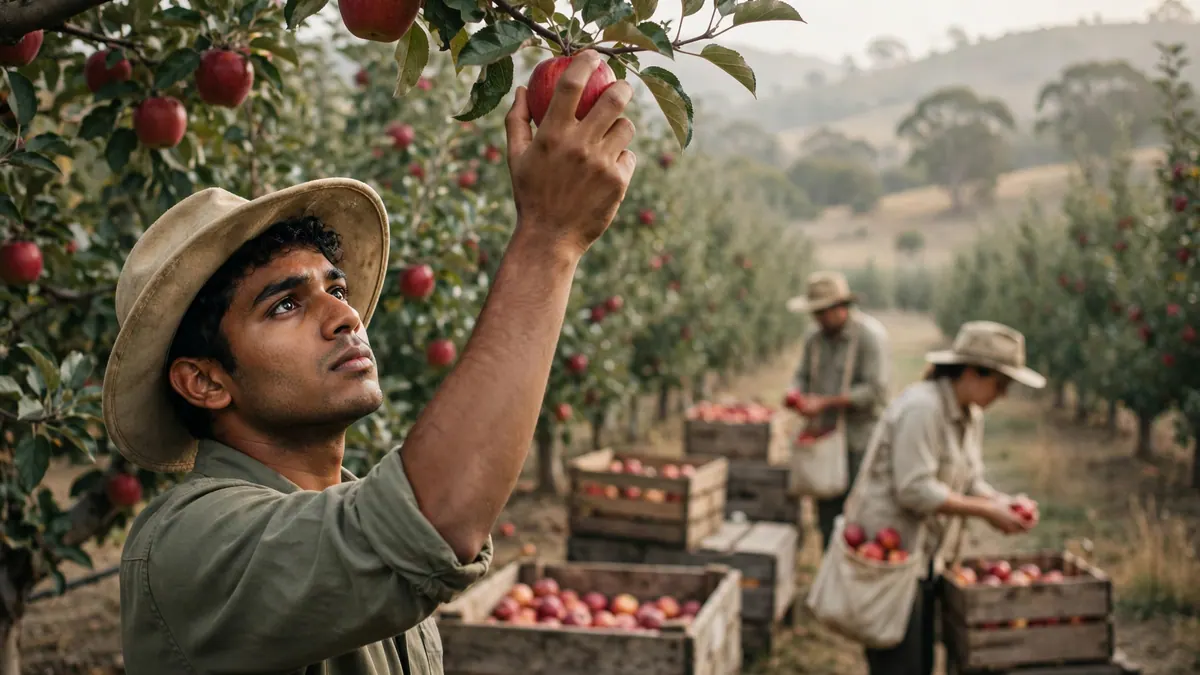
Ahmed is a casual Level 1 picker. His hourly rate including the 25% loading is $32.18 ($25.74 × 1.25). On a 7-hour day he picks and is paid by the kilogram.
- The floor for the day is $32.18 × 7 hours = $225.26. If his piece-rate earnings come to less, the employer must top him up to this amount (cl 15.2(f)).
- The piece rate itself must be set so that an average-productivity competent picker earns at least $37.01 an hour (115% of $32.18), which is $259.05 over 7 hours.
- If the same day were a public holiday and Ahmed were on the hourly rate, it would be paid at 225% of $25.74: $57.92 an hour, $405.44 for 7 hours. A pieceworker is paid 200% of the piece rate on a public holiday (cl 27.3).
Slow days, poor crops or a new task can push earnings below the 15% target, but never below the hourly floor. The award requires the employer to keep a record of hours and the piece rate in force for each pieceworker.
Try your own hours in the overtime pay calculator or the casual loading calculator, add up a full week in the weekly pay calculator, or check the public holiday pay guide.
Horticulture Award Pay Guide 2026-27: Every Level, Every Day
The hourly rate for each classification at each penalty band, in the layout of the Fair Work pay guide. Find your level, then the day you worked.
Full-time and part-time
| Classification | Ordinary hours100% | Public holiday200% |
|---|---|---|
| Level 1 | $25.74 | $51.48 |
| Level 2 | $26.44 | $52.88 |
| Level 3 | $26.84 | $53.68 |
| Level 4 | $27.81 | $55.62 |
| Level 5 | $29.45 | $58.90 |
Casual
| Classification | Ordinary hours125% | Public holiday225% |
|---|---|---|
| Level 1 | $32.18 | $57.92 |
| Level 2 | $33.05 | $59.49 |
| Level 3 | $33.55 | $60.39 |
| Level 4 | $34.76 | $62.57 |
| Level 5 | $36.81 | $66.26 |
Casual figures are the award's casual percentages, which already include the 25% loading where it applies. Figures are rounded to the cent. A dash means the column does not apply to that classification.
Horticulture Award Penalty Rates
| When worked | Full-time / part-time | $ on Level 1 | Casual | $ casual |
|---|---|---|---|---|
| Casual — ordinary hours between 8.31 pm and 4.59 amA further 15% of the ordinary hourly rate on top of the 25% loading (cl 13.2(d)). | – | – | 140% | $36.04 |
| Public holiday (all time worked)Casuals get 225% inclusive of the loading, for both ordinary hours and overtime (cl 27.4). A pieceworker is paid 200% of the piece rate (cl 27.3).Public holiday pay calculator & dates by state → | 200% | $51.48 | 225% | $57.92 |
| Afternoon or night shift (shiftworkers)115% of the ordinary hourly rate (cl 13.3(d)). The award sets no separate casual shift rate. | 115% | $29.60 | – | – |
Source: cl 13.2, 13.3(d) and 27.3–27.4, and Schedule B.2–B.3.
There is no Saturday or Sunday penalty for ordinary hours. Ordinary hours for full-time and part-time employees are worked Monday to Friday, or Monday to Saturday by agreement, between 6.00 am and 6.00 pm unless varied by agreement (cl 13.1). Work outside them is overtime.
A casual's ordinary hourly rate is the minimum plus 25% for any hour worked on any day of the week (except public holidays) between 5.00 am and 8.30 pm (cl 13.2(b)), with a further 15% of the ordinary rate between 8.31 pm and 4.59 am.
For a pieceworker the ordinary hours, meal allowance and overtime clauses do not apply (cl 15.2(b)); what applies instead is the hourly-rate floor on each day worked (cl 15.2(f)).
Horticulture Award Overtime Rates
| Overtime worked | Full-time / part-time | $ on Level 1 |
|---|---|---|
| Monday to Saturday | 150% | $38.61 |
| Sunday — outside the harvest period | 200% | $51.48 |
| Sunday — harvest period, first 5 hours within the first 8 overtime hours of the week | 150% | $38.61 |
| Sunday — harvest period, beyond 8 overtime hours in the week or 5 hours on the Sunday | 200% | $51.48 |
Source: cl 21.3–21.4 and Schedule B.2.3 / B.3.2.
For full-time and part-time employees overtime is all time beyond ordinary hours or outside the 6.00 am to 6.00 pm span (cl 13.1(a)(iv), cl 21.1). Anyone required to work on a Sunday is paid for at least 3 hours (cl 21.3(e)).
A casual's ordinary hours can be worked at any time and any day (cl 13.2(a)), so a casual is paid overtime only for hours beyond 12 in an engagement or day, or beyond 304 ordinary hours over 8 weeks. That overtime is 175% of the ordinary rate, inclusive of the loading (cl 21.4).
Overtime on a public holiday is paid at the public holiday rate: 200% (casuals 225%) (cl 27.3–27.4).
Horticulture Award Junior Rates
Junior rates are a percentage of the adult rate for the classification (cl 15.3), and apply to the adult rate for the classification. The dollar columns apply the percentage to Level 1 ($978.10 a week), round the weekly figure to the nearest $0.10 as the award requires, and divide by 38. The full adult rate applies from age 20.
| Age | % of adult rate | Weekly on Level 1 | Hourly | Casual hourly (+25%) |
|---|---|---|---|---|
| Under 16 | 50% | $489.10 | $12.87 | $16.09 |
| 16 | 60% | $586.90 | $15.44 | $19.30 |
| 17 | 70% | $684.70 | $18.02 | $22.53 |
| 18 | 80% | $782.50 | $20.59 | $25.74 |
| 19 | 90% | $880.30 | $23.17 | $28.96 |
| 20 and over | 100% | $978.10 | $25.74 | $32.18 |
For how junior scales compare across awards and against the National Minimum Wage, see our junior pay rates guide.
Horticulture Award Allowances
Fixed-dollar allowances in cl 18, operative from 1 July 2026. Each is paid only where the clause’s conditions are met.
| Allowance | Amount | Clause |
|---|---|---|
| Leading hand — in charge of 2 to 6 employeesPaid for all purposes. NOT in the rates above. | $30.41 per week | cl 18.2(b) |
| Leading hand — in charge of 7 to 10 employees | $35.43 per week | cl 18.2(b) |
| Leading hand — in charge of 11 to 20 employees | $50.50 per week | cl 18.2(b) |
| Leading hand — in charge of more than 20 employees | $63.46 per week | cl 18.2(b) |
| Wet work allowance (unless adequately protected)Paid for all purposes. | $2.64 per hour | cl 18.2(c) |
| First aid allowance (appointed first aider)Paid for all purposes. | $13.48 per week | cl 18.2(d) |
| Meal allowance (overtime of more than 2 hours, no previous-day notice)Does not apply to a pieceworker. | $16.69 per occasion | cl 18.3(c) |
Minimum Shifts and Hours
- A casual must be engaged and paid for at least 2 consecutive hours each time they attend work (cl 11.3).
- Full-time and part-time ordinary hours are up to 152 over 4 weeks, up to 8 a day (up to 12 by agreement) (cl 13.1). Casual ordinary hours are up to 304 over 8 weeks and 12 a day (cl 13.2).
- Pieceworkers: the employer must give a written piecework record before the task starts, stating the date, task, piece rate and the hourly rate for the pieceworker (cl 15.2(h)).
What does a horticulture award rate take home?
- Take-home on $25.74/hr (Level 1)
- Take-home on $26.44/hr (Level 2)
- Take-home on $27.81/hr (Level 4)
- Take-home on $29.45/hr (Level 5)
Working a mix of shifts? Enter your hours in the weekly pay calculator, or turn a salary into net pay with the take-home pay calculator.
What This Page Does Not Cover
These parts of the award carry rules or rates we have not verified line by line, so we publish no figures for them:
- Piece rates: the award sets no dollar piece rate. It requires one that lets an average-productivity worker earn at least 15% more than the hourly rate (cl 15.2(d)), so what a picker is actually paid per bucket, punnet or kilogram is set by the employer and not published here
- Apprentice and trainee rates (the National Training Wage is in Schedule E to the Miscellaneous Award) and the supported wage system (Schedule D)
- Annualised wage arrangements (cl 17) and accident pay (cl 19)
An enterprise agreement, if one covers your workplace, replaces these award rates — though it must leave you better off overall.
When These Rates Took Effect
Applies from the first full pay period starting on or after 1 July 2026, not universally 1 July. If your pay period began before 1 July 2026, the previous rate lawfully applies to that whole period and the rise starts with the next one. The award was varied by determination PR799309 following the Annual Wage Review 2026. If you have been paid below these rates, our backpay calculator works out what is owed.
Frequently Asked Questions
Horticulture Award questions and answers
What are the horticulture award pay rates for 2026-27?
Under the Horticulture Award 2020 (MA000028), adult minimum rates run from $25.74 an hour ($978.10 a week) for Level 1 to $29.45 an hour ($1,119.10 a week) for Level 5. They apply from the first full pay period starting on or after 1 July 2026.
What is the casual rate under the Horticulture Award?
Casuals receive a 25% loading on the minimum hourly rate, so Level 1 becomes $32.18 an hour. Casual penalty rates add the loading rather than multiplying by it — the casual column in the award is the permanent percentage plus 25 percentage points.
What allowances are paid under the Horticulture Award?
The award's allowances clause (cl 18) includes: leading hand — in charge of 2 to 6 employees $30.41 per week; leading hand — in charge of 7 to 10 employees $35.43 per week; leading hand — in charge of 11 to 20 employees $50.50 per week; leading hand — in charge of more than 20 employees $63.46 per week; wet work allowance (unless adequately protected) $2.64 per hour. Allowances are paid on top of the classification rate when the employee meets the clause's conditions.
What are the junior rates under the Horticulture Award?
Junior rates are a percentage of the adult rate for the classification (cl 15.3): Under 16 50%, 16 60%, 17 70%, 18 80%, 19 90%. The full adult rate applies from age 20. They apply to the adult rate for the classification.
When did the new horticulture award rates start?
Applies from the first full pay period starting on or after 1 July 2026, not universally 1 July. The MA000028 rates were varied by determination PR799309 following the Annual Wage Review 2026. If your pay period started before 1 July 2026, the old rate lawfully applies to that whole period.
Is the lowest Level 1 rate below the national minimum wage?
Yes. The Level 1 minimum of $25.74 an hour is below the national minimum wage of $26.44 an hour ($1,004.90 a week) that applies from 1 July 2026. Fair Work explains that some awards contain introductory pay rates that can be lower than the National Minimum Wage, but the lowest award rate that applies to ongoing employment must be at least $26.44. Level 1 is a new employee's grade and progresses to Level 2 after no more than 3 months' industry experience (Schedule A.1). If you are being paid less than $26.44 an hour after your introductory period, check your level and contact the Fair Work Ombudsman.
What is the minimum hourly rate for fruit picking?
A Level 1 worker, which includes fruit and vegetable picking, thinning and pruning, is paid at least $25.74 an hour, or $32.18 as a casual, from 1 July 2026. Level 2 applies once the worker has 3 months' industry experience. Junior rates apply to workers under 20.
How do piece rates work under the Horticulture Award?
The employer chooses the piece rate (per bucket, punnet, kilogram or similar) but must set it so that a competent worker at average productivity earns at least 15% more per hour than the minimum hourly rate (cl 15.2(d)). Competent means at least 76 hours' experience at the task. Every pieceworker must also be paid at least their hourly rate for each hour worked on the day, and must be given a signed written piecework record before starting.
Is there a casual loading on top of a piece rate?
For a casual pieceworker the 25% casual loading is built into the hourly rate used for the 15% test and the daily floor (cl 15.2(a)(ii), 15.2(f)). It is not added separately to the piece rate itself.
Do horticulture workers get weekend penalty rates?
Not for ordinary hours. Ordinary hours for full-time and part-time workers run Monday to Friday, or Monday to Saturday by agreement, and casuals can be rostered any day between 5.00 am and 8.30 pm at the same casual rate. Overtime is 150% Monday to Saturday and 200% on a Sunday outside the harvest period, with a minimum of 3 hours on a Sunday (cl 21.3).
What are the horticulture casual night rates?
A casual's ordinary hours between 8.31 pm and 4.59 am carry a further 15% loading on top of the 25%, making $36.04 an hour at Level 1 (cl 13.2(d)).
Are backpackers and working holiday makers covered?
Yes. The award covers employees in horticulture regardless of visa status, and the minimum rates and piecework protections apply to everyone. Employees who are underpaid can use the Fair Work Ombudsman's complaint process or our backpay calculator to estimate what is owed.
How these rates were verified▼
Every figure comes from one constants file transcribed on 5 October 2026 from the Fair Work Commission’s consolidated MA000028 award text, which incorporates all amendments up to and including 1 July 2026 (PR799280, PR799309 and PR799466). Clause numbers are cited against each table. Hourly is the published weekly rate divided by 38; derived dollar figures are rounded half up to the cent.
Automated tests pin the published rates, check every hourly rate against its weekly rate, and assert the rules this award is most often modelled wrongly on — including that casual penalties add the loading rather than multiplying by it. Parts of the award we have not verified are listed as gaps rather than estimated.
Sources & References
- 1Consolidated award text — Horticulture Award 2020 (MA000028)— Fair Work Commission
- 2Award summary and pay guide — MA000028— Fair Work Ombudsman
- 3Annual Wage Review 2026— Fair Work Commission
Last verified: 5 October 2026. Our content is based on the latest information from official Australian government sources.
Anita Bell
AuthorFounder & Senior Bookkeeper
Accountancy degree (2015); certified in Xero, QuickBooks Online, MYOB, Saasu, Zoho and Reckon One
Anita Bell earned her accountancy degree in 2015 and has worked as a senior bookkeeper with Prime Bookkeeping for over 5 years. This built her skills in Australian and New Zealand tax legislation and industry regulations. She is certified in Xero, QuickBooks Online, MYOB, Saasu, Zoho and Reckon One, and works with payroll and rostering software including Gusto, Deputy, Tsheets and KeyPay. She has strong experience in hospitality, building and construction, financial services, real estate, ecommerce, and medical and health services.
Areas of Expertise